


A Counter-Manifesto to Radicalism RULES FOR RESTORATION

Our institutions are captured. Our culture is confused. Our politics are downstream from both. Rules for Restoration offers a clear, principled framework for pushing back against destructive ideologies and rebuilding what works—starting where you live.
Be the first to know about launch events.
Restoration is not about outrage. It’s about reclaiming the virtues that sustain a free society—courage, responsibility, truth, and ordered liberty—one decision at a time.

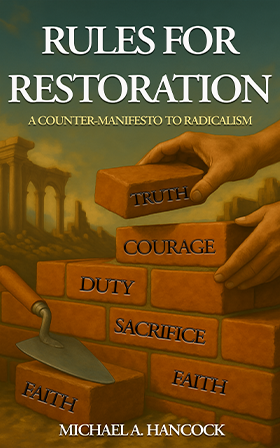
Front Cover Placeholder
The Big Idea

A handbook for rebuilding what radicals tried to destroy.

Where Rules for Radicals taught activists how to tear down existing institutions, Rules for Restorationlays out how to build families, communities, and civic life on a foundation of truth, character, and ordered liberty.

“The radicals wrote the handbook for tearing a society down. It’s time we had one for building it back up.”
About the book
What is Rules for Restoration?
Rules for Restoration: A Counter-Manifesto to Radicalism is a field manual for people who refuse to accept that decline is inevitable.
Drawing from history, theology, classic political thought, and modern cultural analysis, the book:
  • Exposes how radical ideologies colonize language, law, and institutions
  • Reconnects rights back to responsibilities, freedom back to virtue, and law back to moral limits
  • Offers practical “rules” for individuals, churches, communities, and leaders who want to restore rather than revolt
This is not a partisan screed. It’s a roadmap for anyone who senses that something has gone fundamentally wrong—and is ready to do the hard, local, often quiet work of rebuilding.
For whom is this book?

This book is for:
  • Parents and grandparents…
  • Pastors and church leaders navigating cultural chaos
  • Local officials, school board members, and community leaders
  • Entrepreneurs, educators, and creatives building parallel institutions
  • Anyone who still believes restoration is possible
Inside the Book

what you'll learn

Three Parts, One Mission

Rules for Restoration moves from diagnosis to principles to strategy:

  • Part I – Understanding the Radical Mindset
    How we got here, what we’re really up against, and why slogans like “equity” and “inclusion” often conceal very different agendas.
  • Part II – Rules for Restoration
    Core principles for rebuilding a sane, free, and ordered society.
  • Part III – Strategic Pathways Forward
    Practical strategies to break the spell, expose the machinery, build new institutions, and train the next generation.

Key Chapters

  • Win Minds, Not Just Arguments – Why facts alone aren’t enough and how to reach captured minds.
  • Sacrifice for the Common Good – How responsibility, not grievance, holds a free society together.
  • Root Action in Reality – Grounding reforms in how people actually behave, not in ideological fantasies.
  • Reform Culture Before Policy – Why laws can’t save a culture that has abandoned virtue.
  • Respect the Sacred – Recovering reverence for what cannot simply be voted away.
  • Build New Institutions – Creating parallel structures when the old ones are captured.
  • Train the Next Generation to Restore the Republic – Intentional formation, civic literacy, and moral education.
About the Author

Michael Hancock

Michael Hancock is a writer, civic leader, and cultural analyst based in Aurora, Colorado. He has spent years at the intersection of local government, public policy, and grassroots community work—watching up close how culture shapes law, and how bad ideas, once institutionalized, can hollow out communities from the inside.

Rules for Restoration grew out of decades of reading, reflection, and real-world experience: from classic works like Animal Farm and 1984, to thinkers like Adam Smith and Tocqueville, to the daily grind of city council debates, budget fights, and neighborhood conversations.

Beyond the page, Michael is involved in efforts to improve public safety and economic opportunity, help young people develop critical thinking and civic literacy, and challenge weaponized narratives about race, power, and history.

He writes and speaks with a simple conviction: a free society cannot survive on slogans and feelings; it must be sustained by truth, virtue, and people willing to live those out.


Elsewhere you can find his work:
  • Long-form commentary and op-eds
  • A podcast exploring culture, law, and liberty
  • Talks and teaching on civic renewal and moral formation
Civic Renewal Cultural Analysis Faith & Public Life Local Governance